

Portable Oxygen Detector for Mining and Tunnel Engineering
2026-01-30
Portable Oxygen Detector: A Critical Safety Tool for Mining and Tunnel Engineering
In mining areas and tunnel construction sites—typical high-risk confined space environments—maintaining adequate oxygen levels is a prerequisite for ensuring worker safety. Oxygen deficiency, a common hazard in these scenarios, can lead to dizziness, coma, or even fatal accidents. This article explores the significance of oxygen content measurement, core application scenarios of portable oxygen detectors, selection criteria, range selection, calibration methods, and frequently asked questions, providing professional guidance for safety management in mining and tunnel engineering industries.
1. Why Measure Oxygen Content? The Imperative for Safety in High-Risk Environments
Oxygen is essential for human respiration, and the normal oxygen concentration in air is approximately 20.9% VOL. In mining areas and tunnel engineering sites, oxygen content can drop sharply due to multiple factors: first, the confined space structure leads to poor ventilation, making it difficult for oxygen to circulate and replenish; second, mining operations (such as blasting) and tunnel excavation processes consume a large amount of oxygen; third, the leakage of other gases (such as methane, carbon dioxide) in the stratum can dilute the oxygen concentration.
Oxygen deficiency poses an immediate threat to workers' lives. Mild oxygen deficiency causes symptoms such as fatigue, headache, and shortness of breath, affecting work efficiency and judgment; severe oxygen deficiency can lead to loss of consciousness, respiratory failure, and even death within a short period. Additionally, low oxygen environments may exacerbate the risks of flammable and explosive gases. Therefore, real-time measurement of oxygen content using professional oxygen detector or o2 analyzer is not only a basic requirement for occupational health and safety but also a key link in preventing major safety accidents. Such monitoring is an integral part ofenvironmental monitoring equipment and gas detection system in high-risk industries.
2. Core Application Scenarios: Safeguarding Mining and Tunnel Engineering
Portable oxygen detectors are widely used in mining areas and tunnel engineering, serving as a "safety line" for on-site workers. Their core application scenarios include:
2.1 Mining Area Operations
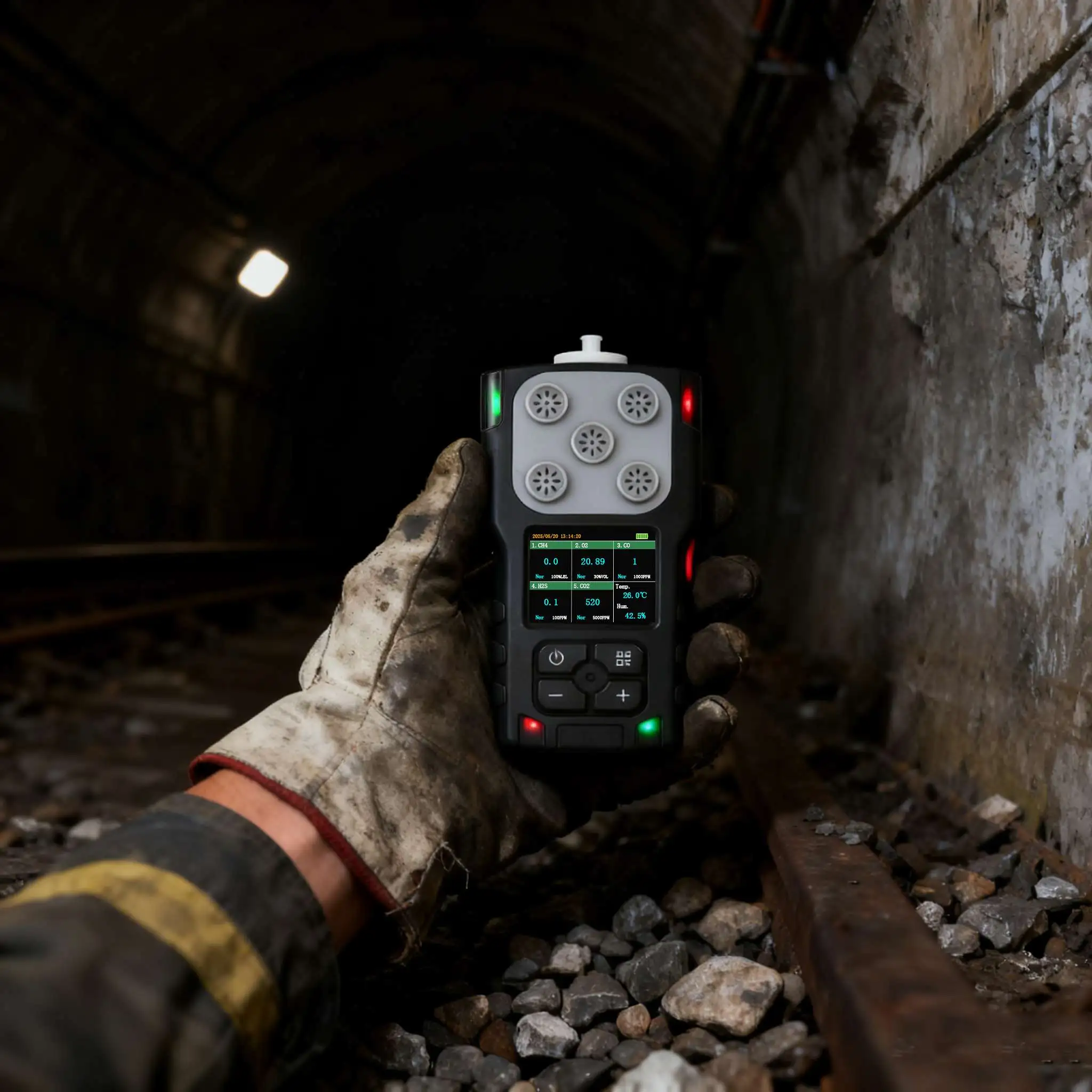
Underground mining tunnels are typical confined spaces with poor ventilation. During ore mining, transportation, and support operations, oxygen is continuously consumed, and the risk of oxygen deficiency is high. Workers must carry portable oxygen detector (or multi gas detector integrated with oxygen detection function) to monitor oxygen content in real time before and during entering the mining face. If the oxygen concentration drops below the safe threshold, the detector will immediately alarm, prompting workers to evacuate or take ventilation measures in a timely manner.
2.2 Tunnel Engineering Construction
Tunnel excavation (such as road tunnels, railway tunnels) often involves deep underground or mountainous areas, where the air environment is complex and oxygen supply is unstable. During the excavation process, the release of harmful gases from the stratum and the consumption of oxygen by construction machinery can easily lead to oxygen deficiency. Portable oxygen detector for confined space is used to conduct pre-entry detection of the tunnel and continuous monitoring during construction. It ensures that the oxygen content in the construction area meets the safety standard, avoiding accidents caused by sudden oxygen deficiency during long-term construction.
3. How to Select a Portable Oxygen Detector for Mining and Tunnel Engineering
Selecting the right portable oxygen detector is crucial for ensuring monitoring accuracy and usability in harsh on-site environments. The following are key selection criteria tailored to mining and tunnel engineering scenarios:
3.1 Compact and Lightweight Design
Workers in mining areas and tunnels need to carry multiple tools and equipment, so the oxygen monitor should be small in size and light in weight. A compact design reduces the burden of long-term carrying, ensuring that workers can move freely during operations. The integration of a clip-on design (back clip) is highly recommended, allowing the detector to be easily attached to clothing or tool belts, preventing loss and facilitating quick access.
3.2 High-Precision Sensing Technology
The core component of the oxygen detector is the O2 sensor, and selecting a high-precision electrochmical oxygen sensor is essential. High-precision sensors can accurately measure subtle changes in oxygen content, ensuring that the monitoring data is reliable—this is critical for early warning of oxygen deficiency. It is recommended to choose detectors with sensors from well-known brands, which have better stability and anti-interference ability, and can adapt to the harsh environment of dust, vibration, and humidity in mining and tunnels.
3.3 Clear and Visible Display
Mining areas and tunnels are often in low-light or dark environments, so the detector must be equipped with a high-brightness LCD display. The display should have clear numbers and intuitive icons, allowing workers to read the oxygen concentration values easily even in dark conditions. Some advanced models are equipped with backlight function, which can further improve visibility in low-light environments.
3.4 Flexible Alarm Setting Function
The oxygen gas detector should support adjustable alarm thresholds to adapt to different safety standards and on-site environments. Generally, it is necessary to set both low-oxygen alarm and high-oxygen alarm (though high-oxygen risks are rare in mining and tunnels, it is still necessary for comprehensive monitoring). The alarm signal should be clear and obvious—combining audible (loud buzzer), visual (flashing red light), and even vibration alarms to ensure that workers can receive the alarm prompt in noisy construction sites.
3.5 Data Storage and Fall Alarm Function
Data storage function is essential for safety management and accident investigation. The detector should be able to record historical monitoring data (such as oxygen concentration changes, alarm times, etc.), which can be exported and analyzed later. Additionally, the fall alarm function is a valuable additional feature for mining and tunnel scenarios—if the detector falls off the worker's body due to collision or other reasons, it will immediately issue a continuous alarm, reminding the worker to retrieve the instrument, ensuring that the monitoring is not interrupted.
4. Range Selection for Oxygen Detectors: Why 0-25% VOL is Preferred for Mining and Tunnels
The range of the o2 gas detector directly affects the accuracy of measurement. In general, the smaller the range, the smaller the measurement error, because the sensor's measurement accuracy is more concentrated in the small range interval. Common oxygen detector ranges include 0-30% VOL, 0-25% VOL, and 0-100% VOL. For mining areas and tunnel engineering, 0-25% VOL is the most suitable range, and the reasons are as follows:
First, the normal oxygen concentration in air is 20.9% VOL, and the safety threshold for oxygen deficiency in confined spaces is generally 19.5% VOL (below which is considered low oxygen). The 0-25% VOL range fully covers the normal oxygen concentration and the possible low-oxygen range in mining and tunnels, ensuring that the detector can accurately monitor changes in oxygen content within the safety-related interval.
Second, selecting a larger range (such as 0-30% VOL or 0-100% VOL) is unnecessary and will reduce measurement accuracy. In mining and tunnel environments, the risk is mainly oxygen deficiency rather than oxygen enrichment (oxygen enrichment is more common in chemical plants or closed reaction vessels). A larger range will spread the sensor's measurement precision, leading to larger errors in the low-oxygen interval that requires key monitoring. For example, a detector with a 0-100% VOL range may have an error of ±5% FS, while a 0-25% VOL range detector can achieve an error of ±3% FS, which is more reliable for early warning of oxygen deficiency.
Third, the 0-25% VOL range detector is more cost-effective. Compared with large-range detectors, small-range detectors have lower production costs while meeting the actual monitoring needs of mining and tunnels, helping enterprises control safety investment costs.
5. How to Calibrate O2 Analyzer: Ensuring Long-Term Measurement Accuracy
Calibration is an important means to maintain the accuracy ofo2 analyzer. With long-term use, the gas sensor detector (including O2 sensor) will have drift, leading to inaccurate measurement results. Therefore, regular calibration is necessary.
5.1 Calibration Cycle
Under normal use conditions, it is recommended to calibrate the oxygen analyzer every 6 months to 1 year. If the detector is used in harsh environments (such as high dust, high humidity, large temperature fluctuations), the calibration cycle should be shortened to 3-6 months to ensure the sensor's performance.
5.2 Calibration Method
Unlike co2 gas detector or toxic gas monitor that require standard gas for calibration, oxygen detectors can be calibrated directly in the air. The specific operation steps are as follows: first, turn on the detector and wait for it to warm up (usually 3-5 minutes); then, enter the calibration mode according to the operation manual; the detector will automatically recognize the oxygen concentration in the air (20.9% VOL) as the standard value and complete the calibration. If you are not familiar with the calibration operation, it is recommended to consult the portable oxygen detector manufacturer or invite professional technicians to perform on-site calibration.
6. Frequently Asked Questions (FAQ) for Oxygen Detection in Mining and Tunnel Engineering
• Q: Can a multi gas detector replace a single oxygen detector in mining areas?
A: Yes, but it is necessary to ensure that the multi gas detector is equipped with a high-precision O2 sensor and meets the oxygen detection requirements for mining scenarios. Multi gas detectors can simultaneously detect oxygen, flammable gases (such as methane), and toxic gases (such as carbon monoxide), which is more efficient for comprehensive risk monitoring in mining areas. However, if the focus is only on oxygen content monitoring, a single oxygen detector is more cost-effective.
• Q: Why does the portable oxygen detector alarm frequently in tunnel construction?
A: Frequent alarms may be caused by two reasons: first, the actual oxygen content in the tunnel is below the safe threshold, which may be due to poor ventilation or excessive consumption of oxygen by construction operations. At this time, it is necessary to stop work immediately, strengthen ventilation, and resume work only after the oxygen concentration returns to normal; second, the detector is faulty or needs calibration. If the oxygen content is confirmed to be normal through other means, it is recommended to check whether the sensor is contaminated or aged, and perform calibration or maintenance in a timely manner.
• Q: Is the backlight function of the oxygen detector necessary for mining areas?
A: Yes, it is very necessary. Most underground mining areas are in dark environments, and the light is extremely insufficient. A detector with a backlight function can ensure that workers can clearly read the oxygen concentration values at any time, avoiding misjudgment caused by unclear display. Some high-brightness backlight designs can also adapt to the harsh environment of dust and water mist in mining areas.
• Q: What is the service life of the electrochemical oxygen sensor in the detector?
A: The service life of a typicalelectrochmical oxygen sensor is 2-3 years, depending on the use environment and frequency. In mining areas and tunnels with high dust, high humidity, and large temperature changes, the sensor life may be shortened. It is recommended to check the sensor's performance regularly (during calibration) and replace the sensor in a timely manner if the measurement error exceeds the allowable range.
• Q: Can the portable oxygen detector be used in high-humidity environments such as water-rich tunnels?
A: It depends on the detector's protection level. When selecting a detector for water-rich tunnels, it is necessary to choose products with high waterproof and dustproof levels (such as IP65 or above). Such detectors adopt a sealed design to prevent water mist and dust from entering the internal components, ensuring stable operation of the O2 sensor and other parts. It should be noted that even waterproof detectors should avoid long-term immersion in water to prevent damage.
Conclusion
In mining areas and tunnel engineering, oxygen content monitoring is a critical link in ensuring worker safety. Selecting a suitable portable oxygen detector—with compact design, high-precision electrochmical oxygen sensor, clear display, flexible alarm functions, and appropriate 0-25% VOL range—and performing regular calibration can effectively prevent oxygen deficiency accidents. As an important part of environmental monitoring equipment and gas detection system, portable oxygen detectors provide reliable technical support for the safe development of high-risk industries. Enterprises should attach great importance to the selection and use of oxygen detection equipment, and strengthen the training of on-site workers on the use and maintenance of detectors to maximize the role of safety protection.
Related News
Contact Us





Fill out the form