

Industry Volatile Organic Compounds detector
2026-01-29
Industrial VOC Gas Detector: A Comprehensive Guide for Hazardous Environment Monitoring
Volatile Organic Compounds (VOCs) are ubiquitous in industrial processes, posing significant risks to human health, environmental safety, and operational compliance. From toxic exposure to fire and explosion hazards, unregulated VOC emissions can lead to severe consequences. Industrial-grade voc gas detector equipped with high-performance voc sensor has become an indispensable tool for enterprises to control VOC risks. This article will elaborate on the composition of VOCs, key industrial application scenarios, advantages of PID detection technology, and common questions about VOC detection, providing professional insights for industries such as petrochemicals, pharmaceuticals, and electronics.
An Overview of Volatile Organic Compounds (VOCs): Key Components and Sources
Volatile Organic Compounds (VOCs) refer to a class of organic compounds that are volatile at room temperature and atmospheric pressure. Their composition is complex, covering multiple chemical categories, and their sources are widespread in both industrial production and daily life. For industrial scenarios, understanding the main components of VOCs is crucial for selecting the appropriate Volatile Organic Compounds detector and formulating targeted monitoring strategies.
The main components of VOCs include the following categories:
• Aromatic hydrocarbons: Such as benzene, toluene, xylene, and styrene. These substances are widely used as solvents in industrial production, such as in paints, coatings, adhesives, and printing inks. They are also common in automobile exhaust and petrochemical by-products. Aromatic hydrocarbons are highly toxic and carcinogenic, posing long-term health risks to workers exposed to them.
• Aldehydes and ketones: Typical representatives are formaldehyde and acetaldehyde. Formaldehyde is a major component of interior decoration materials (such as plywood, paint) and furniture, while acetaldehyde is mainly derived from combustion processes (such as fuel combustion, waste incineration) and chemical synthesis. These substances are irritating to the respiratory tract and eyes, and long-term exposure can damage the immune system.
• Alcohols: Ethanol (alcohol) is the most common, which exists in alcoholic beverages, perfumes, and cleaning products. In industrial settings, alcohols are often used as solvents or raw materials in chemical reactions, such as in the production of pharmaceuticals and cosmetics.
• Esters, alkenes, halocarbons, and others: This category includes ethyl acetate (used in coatings, adhesives), isoprene (a raw material for synthetic rubber), trichloroethylene (a metal degreasing solvent), etc. Their sources cover chemical production, daily chemical products, and natural emissions (such as plant respiration). Many substances in this category are flammable and explosive, and some are toxic and harmful to the environment.
Industrial Application Scenarios of VOC Gas Detectors
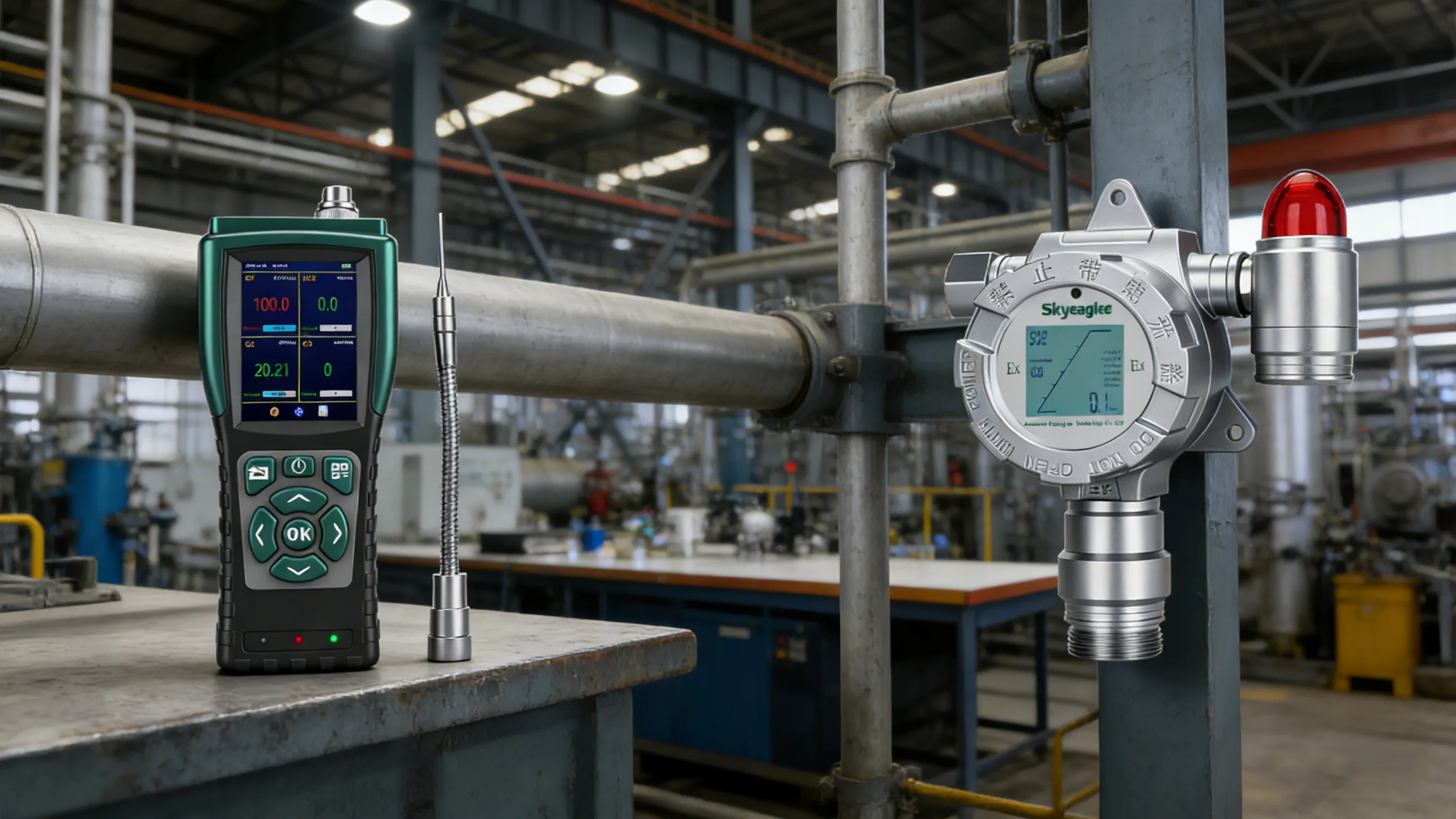
VOCs are widely present in various industrial processes, and voc gas detector (including handheld voc gas detector and Fixed voc gas detector) plays a key role in ensuring production safety and complying with environmental regulations. The following are the core application scenarios across industries:
1. Process Exhaust Emission Ports in Multiple Industries
Key industries: Petrochemical, chemical, pharmaceutical, coating (automobile, furniture manufacturing), printing and packaging, electronics (semiconductor, PCB), petroleum refining, etc. In these industries, VOCs are produced during process operations such as chemical reactions, coating spraying, and solvent volatilization. Fixed voc gas detector is usually installed at the exhaust emission ports to continuously monitor the concentration of VOCs in the exhaust gas, ensuring that the emission indicators meet national and regional environmental protection standards. For enterprises that need to conduct on-site inspection and verification of emission ports, gas analyzer portable is an ideal choice due to its flexibility and portability.
2. Leak Detection in Production Areas of Chemical and Petroleum Enterprises
Application locations: Entire production areas of chemical plants, oil refineries, and oil depots, focusing on potential leak points such as valves, flanges, pumps, compressors, open valves, and connectors. To comply with leak detection and repair (LDAR) regulations, enterprises need to use handheld voc gas detector (equipped with FID/PID detection technology) for regular inspections. The purpose is to timely detect and repair VOC leaks, reduce fugitive emissions, and avoid environmental pollution and safety hazards caused by long-term leakage. The high sensitivity ofVolatile Organic Compounds sensor ensures that even trace leaks can be accurately identified.
3. Storage and Use Areas of Flammable and Explosive Substances
Scenarios: Paint/solvent warehouses, chemical storage tank areas, oil and gas recovery areas, fuel filling stations, etc. In these areas, VOCs are easily volatilized and accumulated, and when the concentration reaches a certain percentage of the lower explosive limit (LEL), it may trigger fire and explosion accidents. Fixed voc gas detector is installed in these areas to continuously monitor the total volatile organic compound concentration. When the concentration approaches the explosion limit percentage, the system can link with ventilation equipment, alarm devices, or shutdown systems to quickly reduce the VOC concentration and prevent safety accidents.
4. Spraying, Gluing, and Drying Production Lines
Industries: Automobile manufacturing, furniture manufacturing, electronic product assembly, etc. Spraying, gluing, and drying processes involve the extensive use of solvents (such as paints, adhesives), which volatilize a large amount of VOCs. Installing Fixed voc gas detector on the production line can real-time monitor the VOC concentration in the workshop environment, ensuring that the working environment meets occupational health and safety standards. For mobile operations or temporary line inspections, handheld voc gas detector can be used to flexibly detect different positions on the production line.
Advantages of PID Photoionization Technology for VOC Detection
Photoionization Detection (PID) technology is widely used in voc gas detector due to its unique advantages, especially suitable for industrial VOC monitoring scenarios. The core advantages of PID technology are as follows:
• Broad Detection Range: PID can detect most VOCs, including aromatic hydrocarbons, aldehydes, ketones, alcohols, esters, etc., and can also detect some inorganic gases (such as ammonia, hydrogen sulfide) that can be ionized. This makes Volatile Organic Compounds detector equipped with PID technology applicable to multiple industrial scenarios, avoiding the limitation of single-component detection.
• High Sensitivity: PID can detect VOC concentrations as low as ppb (parts per billion) level, which is particularly important for leak detection and early warning of trace VOCs. The high sensitivity of voc sensor based on PID technology ensures that potential hazards can be found in the early stage, providing sufficient response time for enterprises.
• Fast Response Speed: PID detectors can quickly respond to changes in VOC concentrations, with a response time usually within a few seconds. This allows real-time monitoring of VOC concentration changes in dynamic industrial processes (such as production line operations, exhaust emission fluctuations), ensuring timely feedback of monitoring data.
• Non-Destructive Detection: PID technology does not destroy the molecular structure of VOCs during the detection process, and the detected gas can be further analyzed if necessary. At the same time, the detector has a long service life and low maintenance cost, which is suitable for long-term continuous monitoring in industrial environments.
• Portable and Flexible: PID technology is widely used in handheld voc gas detector and gas analyzer portable due to its small size and low power consumption. It can be easily carried to different inspection points for on-site detection, which is very suitable for leak detection, temporary monitoring, and emergency response.
Frequently Asked Questions (FAQ) About VOC Gas Detection
• Q: What is the difference between FID and PID technologies in VOC detection, and how to choose?
A: FID (Flame Ionization Detector) has high sensitivity to hydrocarbons but cannot detect non-hydrocarbon VOCs (such as formaldehyde, acetone). It requires a fuel source (such as hydrogen) and is not suitable for use in oxygen-deficient or explosive environments. PID is suitable for most VOCs, has no fuel requirement, and is safer for on-site use. For industries that need to detect a variety of VOCs (such as coating, chemical), PID-based voc gas detector is preferred; for scenarios focusing on hydrocarbon detection (such as petroleum refining), FID detectors can be selected.
• voc sensorQ: How often should the be calibrated, and what are the key points of calibration?
A: It is recommended to calibrate the voc sensor every 6-12 months, or more frequently according to the harshness of the use environment (such as high humidity, high dust, or high concentration of corrosive gases). The key points of calibration include: using a standard gas of known concentration matching the detected VOC type; following the detector's calibration procedure to ensure the accuracy of zero point and span; recording calibration data and replacing the sensor in time if the calibration error exceeds the allowable range.
• Fixed voc gas detectorhandheld voc gas detectorQ: When selecting a and a , what factors should be considered?
A: For fixed detectors: Consider the detection range (matching the maximum possible VOC concentration in the scenario), signal output type (compatible with the enterprise's monitoring system), environmental adaptability (temperature, humidity, dust, corrosion resistance), and linkage function (with ventilation, alarm, shutdown). For handheld detectors: Focus on portability (weight, size), battery life (meeting long-term patrol needs), detection accuracy, data storage and transmission functions, and ease of operation.
• Volatile Organic Compounds detectorQ: Can detect a single VOC component, or only total VOCs (TVOC)?
A: Most common voc gas detector (especially PID/FID types) detects total VOC concentration (TVOC). If single-component VOC detection (such as benzene, formaldehyde) is required, a specialized gas chromatograph or a detector equipped with a selective sensor is needed. For enterprises that need to comply with specific component emission standards, it is recommended to configure both TVOC detectors for real-time monitoring and specialized analytical instruments for periodic component detection.
• voc gas detectorQ: What are the main factors affecting the detection accuracy of in industrial environments?
A: Key influencing factors include: 1. Interference from other gases (such as high concentrations of non-VOC gases may affect the response of the sensor); 2. Environmental conditions (high temperature, high humidity, and dust may damage the sensor or block the sampling port); 3. Sensor aging (long-term use will reduce the sensitivity of the sensor); 4. Incorrect installation (fixed detectors installed too far from leak points or exhaust ports may miss detection). To ensure accuracy, it is necessary to select a detector with strong anti-interference ability, install it correctly, and maintain and calibrate it regularly.
• Q: In the event of a VOC leak alarm, what emergency measures should be taken?
A: First, immediately evacuate on-site personnel to a safe area and activate the emergency alarm system. Then, use handheld voc gas detector to locate the leak point and assess the scope of the hazard. During the process, ensure good ventilation (turn on exhaust equipment) and prohibit open flames, sparks, or other ignition sources. After confirming the leak point, organize professional personnel to repair it. Only after the voc gas detector shows that the concentration returns to a safe range can on-site operations be resumed.
Conclusion
Volatile Organic Compounds (VOCs) pose dual risks to industrial production safety and the environment, making voc gas detector an essential equipment for enterprises in petrochemical, chemical, coating, and other industries. Whether it is Fixed voc gas detector for continuous monitoring orhandheld voc gas detector for flexible inspection, selecting products equipped with high-performance voc sensor (such as PID technology) and matching them to specific application scenarios is the key to effective VOC control. By complying with relevant regulations, conducting regular leak detection and repair, and strengthening on-site monitoring, enterprises can not only avoid safety accidents and environmental pollution but also improve operational efficiency and corporate image. Choosing a professional and reliable Volatile Organic Compounds detector is an investment in the safety of employees and the sustainable development of the enterprise.
Related News
Contact Us





Fill out the form