

How to Select an Ozone Detector for Environmental Monitoring: 2026 Purchasing Guide & Top Considerations
2026-03-13
How to Select an Ozone Detector for Environmental Monitoring: 2026 Purchasing Guide & Top Considerations
Is Your Facility Looking for an Ozone Monitor, or Looking for a Solution That Works?
If you are an environmental health and safety (EHS) manager, a lab director, or a facility operator searching for an "monitoreo ambiental detector de ozono para ambiente," you are likely facing a specific problem: you need to measure ground-level ozone accurately to ensure compliance, protect employee health, or validate your purification systems.
As highlighted in a leading industry ozone sensor market research report, steady global demand across food & beverage, wastewater treatment, and other industrial sectors continues to fuel consistent growth in the ozone monitoring equipment market, underscoring the critical need for reliable detection solutions across operations. You’ve probably seen a flood of low-cost detectors online. However, if your goal is to purchase a device that provides reliable data without failing an audit or giving you false safety readings, you are in the right place. This guide is not a basic science lesson; it is a procurement checklist designed to help you navigate the market, understand what separates a $55 sensor from a $5,000 analyzer, and ultimately choose the device that fits your operational needs and budget.
What Is the Real Investment for an Effective Ozone Detector?
When planning your budget for environmental monitoring equipment, it is crucial to look beyond the initial sticker price. The total cost of ownership varies dramatically based on the technology inside the box.
For small teams (under 50 people) or localized projects, a reliable portable or semi-professional ozone detector using electrochemical sensors typically starts in the range of $1,200 to $1,500 USD per unit . These devices are suitable for spot-checking and general workplace safety.
However, if your application requires high-precision data—such as for regulatory reporting, scientific research, or monitoring in cleanrooms—you will need to invest in UV absorption or chemical fluorescence technology. These professional-grade instruments generally start around $4,000 USD and can exceed $12,000 USD . If your project requires custom integration, specific data logging protocols, or multi-gas analysis, the development and configuration costs typically start at over $5,000 USD.
Why this matters to you: Investing in a device that is "too cheap" often leads to inaccurate readings. Studies have shown that many low-cost monitors (under $200) fail to detect ozone levels below 100 PPB—which is precisely the range where the WHO sets safety limits . You don't just need a device; you need a device that works within the parameters you require.
3 Questions You Must Ask Before Buying an Ozone Detector
To help you avoid costly mistakes, we have translated complex technical specs into a buyer's inspection checklist. When evaluating an ozone detector, do not just look at the brochure. Ask the supplier these three specific questions:
1. What is the sampling method: Diffusion or Pump suction?
You need to understand how the air reaches the sensor.
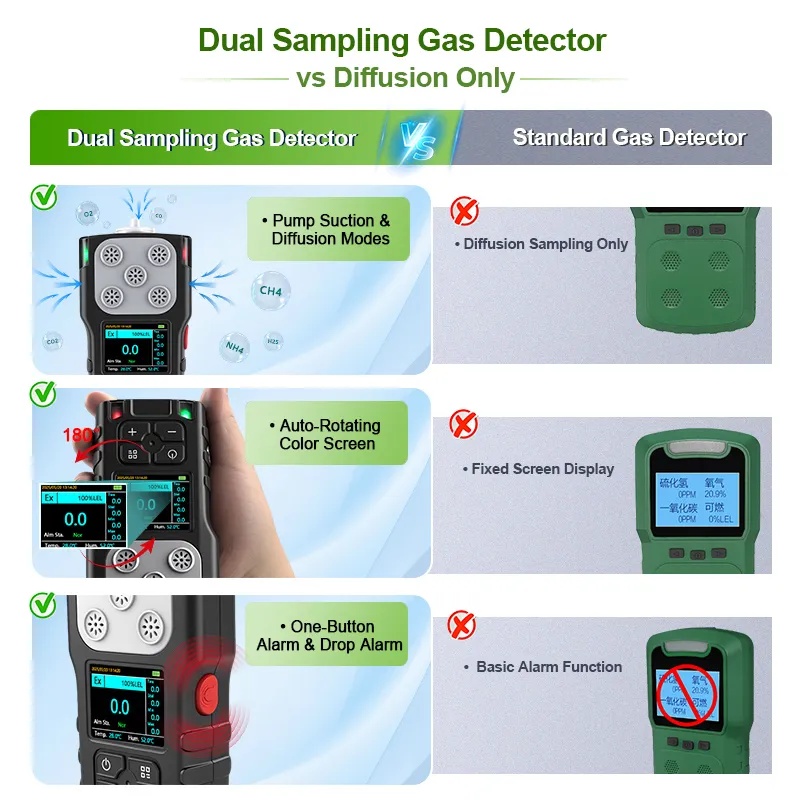
Diffusion sampling relies on air passively drifting into the sensor. It is fine for general area monitoring but can be slow to react.
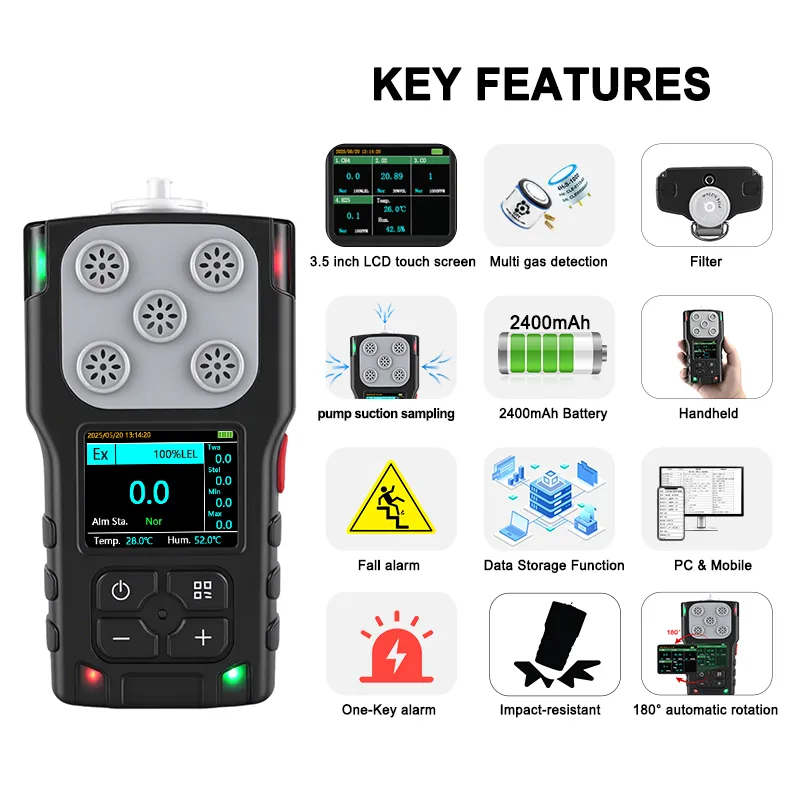
Pump suction (active sampling) uses an internal pump to draw air into the sensor chamber. This is critical for industrial environments or when you need to spot-check a specific leak source quickly. It ensures a faster response time (T90) and more reliable readings in harsh conditions .
2. Is the battery designed for your shift or your workweek?
If you are purchasing a portable monitor for field use, battery life is a hidden trap. A device that dies after 4 hours is useless for an 8-hour shift. Look for devices with at least 6-8 hours of runtime. Furthermore, ask about the type of battery and its safety certifications, especially if you work in volatile environments .
3. Does it log data, or just show a number?
A professional procurement requires documentation. You need a unit that does more than just beep. Ensure the device has internal memory to store alarm records and historical concentration values. Can you export that data? Does it have a communication interface (like RS232, RS485, or 4G) to integrate with your existing building management system? Data logging is what turns a "tester" into a true environmental monitor .
 |
 |
Navigating the difference between electrochemical, UV, and semiconductor sensors can be overwhelming. Do you need a fixed installation or a portable unit? Is ppb-level accuracy a "nice-to-have" or a "must-have" for your compliance?
Unsure which monitor fits your specific environmental conditions and budget? Don't guess when it comes to safety and compliance.
[Click here to contact our selection consultants] . We offer a free, no-obligation consultation to help you assess your requirements and filter through the technical noise to find the perfect fit for your facility.
Related News
Contact Us





Fill out the form