

Essential Protection for HCl-Related Industrial Operations
2026-02-05
Hydrogen Chloride Detector: Essential Protection for HCl-Related Industrial Operations
Hydrogen chloride (HCl) is a common industrial gas with unique physical and chemical properties that make it both valuable in production and potentially hazardous if not properly monitored. As a critical raw material and byproduct in multiple industries, the safe use and detection of HCl are vital to ensuring operational safety, personnel health, and production stability. This article elaborates on the properties of HCl gas, the advantages of our hydrogen chloride detectors, the application scope of HCl, brief leakage cases, and the core safety objectives of HCl detection, providing professional guidance for industries involving hydrogen chloride.
1. An Overview of Hydrogen Chloride (HCl) Gas Properties
Hydrogen chloride is a colorless gas with a pungent, irritating odor that is easily detectable by the human sense of smell at low concentrations. Chemically, it is a highly corrosive acidic gas that readily dissolves in water to form hydrochloric acid, a strong acid that can corrode metals, rubber, and other materials. At room temperature and atmospheric pressure, HCl gas is stable but exhibits strong reactivity, capable of reacting with bases, metals, and some organic compounds. Its density is slightly higher than that of air, meaning it tends to accumulate in low-lying areas, trenches, or poorly ventilated spaces when leaked. While HCl plays an irreplaceable role in industrial production, its corrosiveness and toxicity pose significant risks to personnel and equipment, making the use of a reliable Hydrogen chloride detector, Hydrogen chloride gas detector, or HCL gas detector indispensable.
2. Advantages of Our Hydrogen Chloride Detectors
We offer two types of hydrogen chloride detection equipment-fixed and portable-to meet the diverse monitoring needs of different industrial scenarios. Both products are engineered with advanced technology and user-friendly designs, fully ensuring the accuracy, reliability, and convenience of HCl gas detection.
2.1 Fixed Hydrogen Chloride Gas Detector
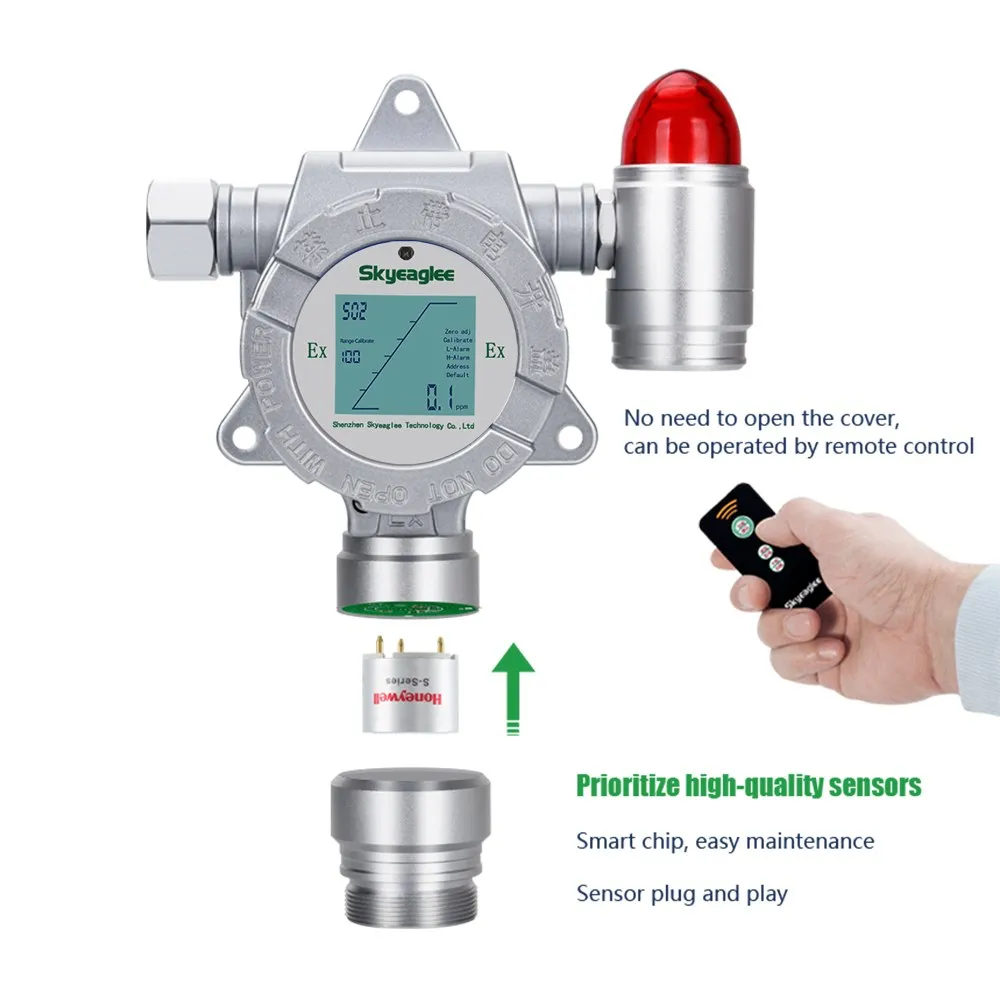
Our fixed Hydrogen chloride gas detector is designed for long-term, continuous monitoring of HCl concentrations in industrial sites, with the following core advantages. It supports fixed installation and can be connected to air chambers to measure gas concentrations in pipelines, while also adopting diffusion sampling technology to monitor the gas environment in the surrounding area. This enables 24-hour real-time monitoring, ensuring no leakage is missed at any time. The detector is equipped with a three-level alarm function, which can be set according to actual safety needs; when the HCl concentration exceeds the preset threshold, it will immediately trigger an alarm to prompt on-site personnel to take emergency measures.
In terms of signal output, it supports RS485 and 4-20mA dual signals, which can be seamlessly integrated with the on-site safety control system to realize linkage control with ventilation equipment, shut-off valves, and other devices. The detector is equipped with a remote control for convenient operation, eliminating the need for on-site disassembly and adjustment. It adopts a core imported sensor and intelligent chip, ensuring high detection accuracy and stable performance, and can be used immediately after power-on without complex debugging. The LCD display screen provides clear data reading, with a resolution as low as 0.01, enabling accurate monitoring of trace HCl concentrations.
The HCL gas detector also supports multiple functional settings, including calibration, zero adjustment, high alarm setting, low alarm setting, address setting, and reset operation, fully meeting the daily maintenance and use needs of industrial sites. Additionally, it supports gas customization, which can be tailored according to the specific HCl detection requirements of different industries and scenarios, providing personalized monitoring solutions.
2.2 Portable Hydrogen Chloride Gas Detector
Our portable Hydrogen chloride detector is designed for mobile monitoring scenarios, featuring compact size and easy portability, allowing on-site personnel to carry it with them for patrol detection. It is equipped with a 27mm sampling probe and adopts pump-suction sampling technology, which can quickly and accurately collect gas samples from designated positions-especially suitable for detecting HCl concentrations in narrow spaces, pipeline interfaces, and other hard-to-reach areas. The detector is equipped with an LCD display screen that can display historical concentration curves in real time, enabling on-site personnel to intuitively grasp the changes in HCl concentration over a period of time.
It supports three-level calibration and zero adjustment functions, ensuring the long-term accuracy of detection data. Users can freely set high and low alarm thresholds according to actual needs, and the detector will issue a clear alarm signal when the HCl concentration exceeds the threshold. The portable HCL gas detector also has a data storage function, which can store historical detection data and alarm records for later query and analysis. It supports USB data export, allowing users to export stored data to a computer for further sorting and reporting, facilitating safety management and compliance verification.
3. Application Scope of Hydrogen Chloride
Hydrogen chloride is widely used in various industrial fields due to its unique chemical properties, and each application scenario requires strict monitoring with a Hydrogen chloride gas detector to prevent leakage risks. Its main application scopes are as follows:
3.1 Chemical Industry and Organic Synthesis
The production of vinyl chloride monomer (VCM) is the largest consumer of HCl. Hydrogen chloride reacts with acetylene or ethylene to generate vinyl chloride, which is further polymerized into polyvinyl chloride (PVC)-a widely used plastic in construction, packaging, and other fields. In this production process, HCl is used as a key raw material, and the risk of leakage exists in pipelines and reaction kettles, requiring real-time monitoring with an HCL gas detector. HCl is also used to produce various chlorides: inorganic chlorides such as ferric chloride (used as a water purifier and etchant), aluminum chloride (used as a catalyst), and calcium chloride (used as a deicing agent and desiccant); organic chlorides, which are used as raw materials or catalysts in the production of pesticides, pharmaceutical intermediates, dyes, refrigerants, and other products.
3.2 Hydrometallurgy and Metal Processing
In hydrometallurgy and metal processing, hydrochloric acid (formed by dissolving HCl in water) is used for metal surface cleaning and pickling-a key step in metal processing and electroplating pretreatment. It can effectively remove oxide scales (such as rust and iron oxide) on the surface of steel, copper, and other metals, ensuring the quality of subsequent processing. In addition, HCl is used in ore processing and extraction to leach and purify certain metals, such as the preparation of rare earth chlorides and the purification of tungsten and titanium. In these processes, HCl leakage may occur during storage and transportation, making the portable Hydrogen chloride detector an essential tool for on-site patrols.
3.3 Food Industry
Food-grade hydrochloric acid, which is strictly purified, is used as an acidity regulator and additive in the food industry. It is used to adjust the pH value of food, ensuring the stability and taste of food; it is also used in the production of monosodium glutamate (sodium glutamate), amino acids, hydrolyzed vegetable protein, pectin, and gelatin. In food production, the use of HCl must comply with strict safety standards, and the Hydrogen chloride detector is used to monitor the HCl concentration in the production environment to avoid contamination of food and harm to operators.
3.4 Other Application Fields
In the chlor-alkali industry, which produces caustic soda and chlorine by electrolyzing brine, a large amount of hydrogen chloride is produced as a byproduct. Recycling this byproduct to make hydrochloric acid or use it in other syntheses is an important link in realizing resource recycling, and the HCL gas detector is used to monitor the leakage of byproduct HCl. In the sugar industry, HCl is used for the acidification and neutralization of syrup; in the rubber industry, it is used for the coagulation of natural rubber. In all these fields, HCl detection is a necessary safety measure to ensure production safety.
4. Brief Case of HCl Gas Leakage
A chemical plant engaged in PVC production experienced an HCl gas leakage accident during the transportation of hydrogen chloride. Due to the aging of the pipeline flange, a small amount of HCl gas leaked and accumulated in the low-lying area of the workshop. At that time, the on-site fixed HCL gas detector failed to be calibrated in time, resulting in delayed alarm. Several operators in the workshop inhaled the irritating gas and developed symptoms such as coughing and eye stinging. After the accident was discovered, the workshop was evacuated immediately, the leakage point was sealed, and ventilation measures were taken. This case shows that the timely and accurate detection of HCl gas is crucial, and the regular calibration and proper use of the Hydrogen chloride detector are important guarantees to prevent leakage accidents.
5. Core Safety Objectives of HCl Gas Detection
The core purpose of detecting HCl gas with a Hydrogen chloride detector, Hydrogen chloride gas detector, or HCL gas detector is to ensure the safety of on-site personnel, protect equipment and the environment, and maintain stable production. Specifically, it includes the following aspects:
5.1 Protecting Personnel Life and Health
HCl gas has strong irritancy and corrosiveness. Inhalation of low-concentration HCl can cause irritation to the respiratory tract and eyes, while high-concentration inhalation can lead to pulmonary edema, respiratory failure, and other serious health problems. The HCL gas detector can detect trace HCl leaks in advance and trigger an alarm at a safe concentration threshold, providing sufficient time for on-site personnel to evacuate and take protective measures, effectively avoiding personal injury caused by HCl exposure.
5.2 Preventing Equipment Damage and Production Accidents
HCl gas and its aqueous solution (hydrochloric acid) are highly corrosive and can corrode industrial equipment such as pipelines, reaction kettles, and storage tanks, leading to equipment failure and even large-scale leakage. Early detection of HCl leaks through the Hydrogen chloride gas detector can help maintenance personnel find and repair leakage points in time, avoid equipment damage, and prevent small leaks from escalating into major production accidents such as production suspension and equipment explosion.
5.3 Ensuring Environmental Safety and Compliance
Uncontrolled leakage of HCl gas will pollute the air and soil, and even affect the surrounding ecological environment, violating environmental protection regulations. The HCL gas detector can monitor the HCl concentration in the production environment and exhaust gas in real time, ensuring that the emission of HCl meets national and industrial standards, helping enterprises avoid environmental pollution accidents and legal liabilities.
5.4 Maintaining Stable Production
HCl is a key raw material or byproduct in many industrial production processes. The stability of its concentration directly affects the quality of products and the smooth progress of production. The Hydrogen chloride detector can monitor the HCl concentration in real time, providing accurate data support for production adjustment, ensuring the stability of the production process, and avoiding production interruption or product quality problems caused by abnormal HCl concentration.
Conclusion
Hydrogen chloride is an indispensable gas in industrial production, but its corrosiveness and toxicity pose significant safety risks to personnel, equipment, and the environment. Our fixed and portable Hydrogen chloride detectors, with their advanced technology, stable performance, and user-friendly design, provide comprehensive monitoring solutions for various HCl-related industrial scenarios. Whether it is 24-hour continuous monitoring of fixed production sites or mobile patrol detection of multiple points, our Hydrogen chloride gas detector and HCL gas detector can accurately and timely detect HCl concentration changes, ensuring the safety of personnel and production.
With the continuous development of industries such as chemical engineering, metallurgy, and food processing, the demand for HCl detection will continue to grow. We will continue to optimize product performance, improve detection accuracy, and provide more professional and reliable HCl detection equipment, helping enterprises realize safe, efficient, and compliant production.
Related News
Contact Us





Fill out the form