

Fixed 4-in-1 Gas Detector for Heavy Industry
Release time:2026-08-07
Source:来源
Heavy Industry Application of the Fixed 4-in-1 Gas Detector
When safeguarding personnel and assets in extreme industrial sectors, standard equipment often falls short. This case study demonstrates the deployment of our industrial multi-gas monitor in a highly demanding, high-dust environment. Engineered for durability, this fixed 4-in-1 gas detector delivers precise, real-time data to prevent catastrophic safety failures.
Superior Performance in Harsh and High-Dust Environments
By analyzing the installation background, it is evident that this device is operating in a classic heavy industry setting. The detector is built to withstand extreme conditions while maintaining our signature clean, wire-free installation aesthetic to prevent cable wear and eliminate tripping hazards in complex workspaces.
Severe Dust Processing Areas
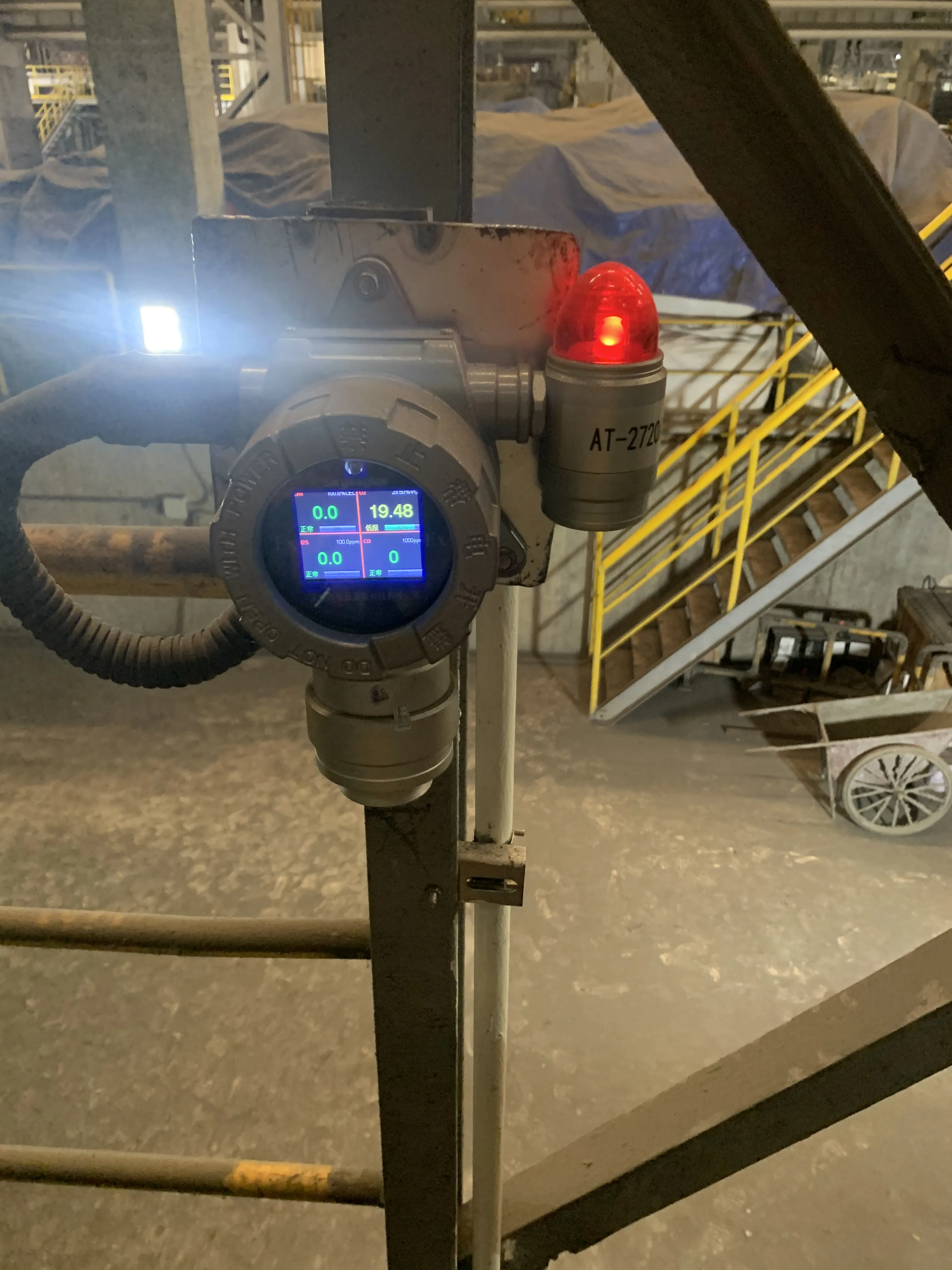
The ground in this facility is covered with a thick layer of grey-white dust, featuring scattered footprints. This strongly indicates a bulk material processing or handling center, such as a cement plant, coal washing facility, fertilizer plant, ore crushing workshop, or metallurgical beneficiation plant. The robust enclosure of the gas detector ensures that heavy particulate matter does not compromise sensor accuracy.
Multi-Level Steel Structure Platforms
The device is securely mounted on a mottled, dark load-bearing steel column. In the background, yellow-painted warning handrails and overlapping multi-level steel platforms are clearly visible. This strategic deployment places the industrial multi-gas monitor directly along the daily inspection routes and working platforms, serving as a critical frontline defense for workers' respiratory safety.
Material Storage and Transfer Zones
To the right of the frame, a traditional two-wheeled handcart—commonly used for short-distance slag removal or material transport—is parked. In the distance, massive blue tarpaulins cover bulk materials or pending equipment. This further confirms the setting as a traditional heavy industry production or warehousing workshop, where environmental hazards can shift rapidly.
Comprehensive 4-Gas Monitoring System
By examining the high-definition color screen and the factory settings typical of an industrial multi-gas monitor, this specific online composite detector is actively measuring the following standard four-gas configuration:
Oxygen (O2) Monitoring
The top right corner of the display reads 19.48 %VOL. Normal atmospheric oxygen concentration is approximately 20.9%. A reading of 19.48% is slightly low but remains within the safe operational range (alarms are typically triggered when levels drop below 19.5%). This real-time data is the core metric for ensuring operators do not enter an oxygen-deficient environment.
Combustible Gas (EX) Detection
Displaying an "Ex" explosion-proof logo, the top left reading sits at 0.0 %LEL. In heavy dust and heavy industry environments, combustible gas channels (such as methane) are essential to prevent dust explosions or pipeline gas leaks. The current zero reading confirms the immediate area is free of explosive threats.
Toxic Gases: Carbon Monoxide (CO) & Hydrogen Sulfide (H2S)
The two bottom channels display readings of 0.0 ppm and 0 ppm, respectively. This perfectly aligns with standard industrial configurations for monitoring two of the most common and deadly toxic gases: Carbon Monoxide and Hydrogen Sulfide. In closed or semi-closed factory settings, continuous defense against these highly toxic gases is a mandatory standard for safe production.
Why Choose Our Industrial Gas Detector Wholesale Solutions?
For distributors and engineering procurement teams, sourcing an industrial multi-gas monitor that combines heavy-duty durability with high-precision electrochemical sensors is vital. Our devices not only offer robust 316L stainless steel protection and high-penetration sound and light alarms but also support a professional, wire-free installation standard that elevates the safety and visual management of any industrial facility.
Heavy Industry Application of the Fixed 4-in-1 Gas Detector
When safeguarding personnel and assets in extreme industrial sectors, standard equipment often falls short. This case study demonstrates the deployment of our industrial multi-gas monitor in a highly demanding, high-dust environment. Engineered for durability, this fixed 4-in-1 gas detector delivers precise, real-time data to prevent catastrophic safety failures.
Superior Performance in Harsh and High-Dust Environments
By analyzing the installation background, it is evident that this device is operating in a classic heavy industry setting. The detector is built to withstand extreme conditions while maintaining our signature clean, wire-free installation aesthetic to prevent cable wear and eliminate tripping hazards in complex workspaces.
Severe Dust Processing Areas
The ground in this facility is covered with a thick layer of grey-white dust, featuring scattered footprints. This strongly indicates a bulk material processing or handling center, such as a cement plant, coal washing facility, fertilizer plant, ore crushing workshop, or metallurgical beneficiation plant. The robust enclosure of the gas detector ensures that heavy particulate matter does not compromise sensor accuracy.
Multi-Level Steel Structure Platforms
The device is securely mounted on a mottled, dark load-bearing steel column. In the background, yellow-painted warning handrails and overlapping multi-level steel platforms are clearly visible. This strategic deployment places the industrial multi-gas monitor directly along the daily inspection routes and working platforms, serving as a critical frontline defense for workers' respiratory safety.
Material Storage and Transfer Zones
To the right of the frame, a traditional two-wheeled handcart—commonly used for short-distance slag removal or material transport—is parked. In the distance, massive blue tarpaulins cover bulk materials or pending equipment. This further confirms the setting as a traditional heavy industry production or warehousing workshop, where environmental hazards can shift rapidly.
Comprehensive 4-Gas Monitoring System
By examining the high-definition color screen and the factory settings typical of an industrial multi-gas monitor, this specific online composite detector is actively measuring the following standard four-gas configuration:
Oxygen (O2) Monitoring
The top right corner of the display reads 19.48 %VOL. Normal atmospheric oxygen concentration is approximately 20.9%. A reading of 19.48% is slightly low but remains within the safe operational range (alarms are typically triggered when levels drop below 19.5%). This real-time data is the core metric for ensuring operators do not enter an oxygen-deficient environment.
Combustible Gas (EX) Detection
Displaying an "Ex" explosion-proof logo, the top left reading sits at 0.0 %LEL. In heavy dust and heavy industry environments, combustible gas channels (such as methane) are essential to prevent dust explosions or pipeline gas leaks. The current zero reading confirms the immediate area is free of explosive threats.
Toxic Gases: Carbon Monoxide (CO) & Hydrogen Sulfide (H2S)
The two bottom channels display readings of 0.0 ppm and 0 ppm, respectively. This perfectly aligns with standard industrial configurations for monitoring two of the most common and deadly toxic gases: Carbon Monoxide and Hydrogen Sulfide. In closed or semi-closed factory settings, continuous defense against these highly toxic gases is a mandatory standard for safe production.
Why Choose Our Industrial Gas Detector Wholesale Solutions?
For distributors and engineering procurement teams, sourcing an industrial multi-gas monitor that combines heavy-duty durability with high-precision electrochemical sensors is vital. Our devices not only offer robust 316L stainless steel protection and high-penetration sound and light alarms but also support a professional, wire-free installation standard that elevates the safety and visual management of any industrial facility.
no data
Contact Us





Fill out the form