

3-in-1 Portable Pump Suction Multi Gas Detector H2S NH3 CH4
Release time:2026-07-06
Source:来源
Common Safety Misconceptions in Industrial Gas Detection
Most industrial safety programs focus heavily on explosive gas risks, but often overlook toxic and irritant gases that pose equal or even greater threats to frontline workers. These common misconceptions create invisible safety blind spots, and many gas exposure incidents happen precisely because of incomplete detection schemes. A people-first safety management strategy requires full-coverage gas monitoring, not just explosion prevention.
Why Single-Gas Monitoring Leaves Workers at Severe Risks
Single-gas detectors only address one specific hazard, while most industrial working environments produce multiple harmful gases at the same time. Relying on single-gas equipment means workers are completely unprotected against other unseen hazards, which is both a violation of occupational safety regulations and a disregard for worker health.
Sewer & Confined Space Work: Ignoring H2S Toxicity While Only Testing CH4
Sewer pipelines, underground trenches, septic tanks and other confined spaces are classic high-risk work sites. Most teams only carry CH4 methane detectors to prevent explosion accidents, but completely ignore H2S hydrogen sulfide generated by organic decomposition.
H2S is a highly toxic neurotoxin that paralyzes the human olfactory nerve at high concentrations, meaning workers cannot smell the rotten egg odor before losing consciousness. Even low-level long-term exposure causes dizziness, nausea, respiratory damage and chronic health issues. Many confined space poisoning incidents are caused by only testing for flammable gas and ignoring H2S.
Livestock & Wastewater Facilities: Overlooking NH3 Hazards Beyond Biogas Explosion
Intensive livestock farms, wastewater treatment plants and landfill sites generate both CH4 biogas and NH3 ammonia from organic matter decomposition. Most facility managers only monitor CH4 to avoid explosion risks, but rarely pay attention to NH3 concentration levels.
NH3 ammonia is a highly corrosive and irritant gas. Short-term high-concentration exposure burns the respiratory tract and damages eye tissue, while long-term low-concentration exposure causes chronic respiratory diseases and reduced immune function for workers. Ignoring NH3 monitoring is a typical oversight that prioritizes property safety over worker health.
3-in-1 Pump Suction Multi Gas Detector: Your People-First Safety Solution
Our portable pump suction multi gas detector is designed specifically to solve these industry pain points. It integrates simultaneous detection of H2S hydrogen sulfide, NH3 ammonia and CH4 methane into one handheld device, eliminating the need for multiple single-gas detectors. With pump suction sampling technology and a portable design, it adapts to various complex field environments and truly implements people-first safety management.
Core Design Built for Mobile Field Inspection
Unlike fixed gas detectors, this device is built for mobile inspection and on-site testing scenarios. Its design fully considers the actual needs of frontline inspectors and outdoor workers.
Pump Suction Sampling with Flexible Gooseneck Probe
Equipped with built-in pump suction technology, the detector actively draws gas samples for testing, which delivers faster response speed and more accurate readings than passive diffusion detectors. The flexible gooseneck probe can be extended into narrow pipeline openings, manholes, corners of livestock houses and other hard-to-reach positions for sampling, without requiring workers to lean into dangerous spaces in advance.
Vehicle-Mounted Portable Design for On-the-Go Patrol
The handheld lightweight body is easy to carry and can be placed in vehicles for mobile patrol inspection. It is suitable for inspectors who need to travel between multiple work sites, such as sewer network patrol teams and environmental inspection personnel. The rugged housing and long battery life support long-term outdoor work and adapt to harsh industrial environments.
Comprehensive Gas Detection Coverage You Can Trust
The detector covers three core gas hazards in industrial and municipal scenarios, providing all-round protection for every worker on site.
Real-Time Readings for H2S, NH3 and CH4
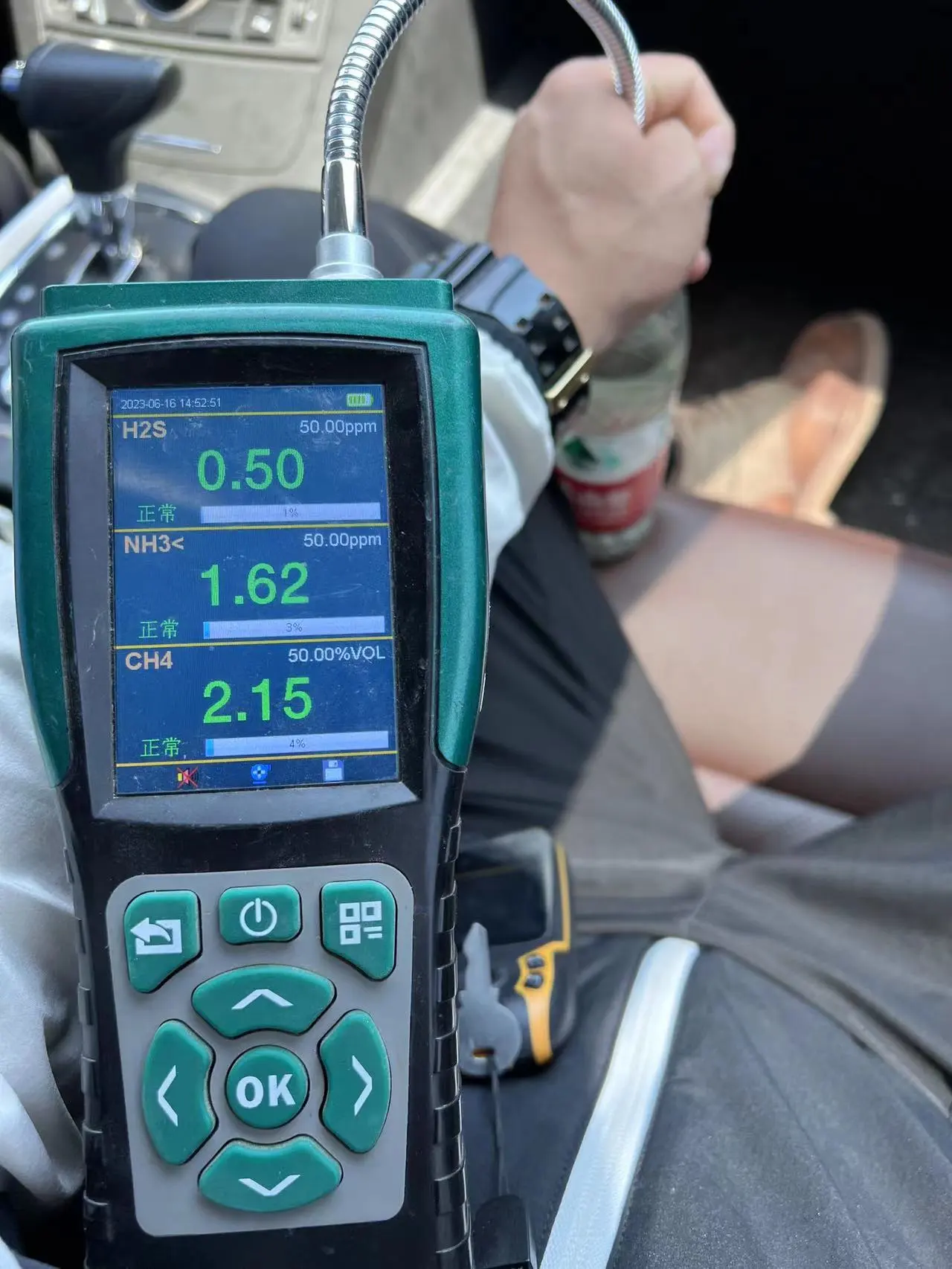
The large clear display shows real-time concentration values of all three gases simultaneously, so workers can grasp the on-site gas status at a glance without professional data analysis.
As shown in the field test, the detector can quickly capture gas concentration changes: for example, H2S 0.50 ppm, NH3 1.62 ppm and CH4 2.15 %VOL, all within safe ranges. The intuitive interface reduces operation difficulty and avoids misjudgment caused by insufficient professional knowledge.
Pre-Set Threshold Alarms for Immediate Risk Warning
Each gas type has scientifically pre-configured safety alarm thresholds that comply with national occupational safety standards. When any gas concentration exceeds the safe limit, the device triggers audible, visual and vibration alarms simultaneously.
This automatic alarm mechanism ensures that workers can receive risk warnings immediately even in noisy environments, low-light conditions or when they are focused on work. It eliminates the risk of human error in judgment and builds a solid safety defense line for frontline workers.
Key Application Scenarios for Full Compliance
This multi gas detector is widely used in various industries that involve gas risk, helping enterprises meet safety compliance requirements and protect worker health.
Confined Space Entry Operations
It is standard equipment for confined space entry work such as sewer pipelines, underground trenches, sealed storage tanks, mine tunnels and septic tanks. It supports pre-entry gas testing and continuous real-time monitoring during operation, fully complying with confined space safety operation specifications.
Municipal Sewer & Wastewater Management
For municipal sewer network patrol, wastewater treatment plants and landfill sites, the detector can simultaneously monitor H2S, NH3 and CH4 generated by organic decomposition, helping inspection personnel grasp the gas status of each pipe section and treatment unit in time, and prevent poisoning and explosion accidents.
Livestock Farms & Biogas Projects
Intensive livestock farms and biogas projects can use this detector to monitor both CH4 biogas explosion risks and NH3 ammonia concentration in livestock houses. It helps optimize ventilation schemes based on actual detection data, improve the working environment for farm workers, and reduce the health damage caused by long-term ammonia exposure.
Natural Gas Pipeline Leak Inspection
For natural gas pipeline network patrol and gas facility maintenance, the high-sensitivity CH4 detection function can quickly locate tiny leakage points, ensuring the safe operation of gas pipelines and facilities.
Standard 3-Step Gas Testing Procedure for Confined Space Work
Standardized operation procedures are the core of implementing people-first safety management. Follow this 3-step gas testing procedure for every confined space entry to maximize worker safety:
Step 1: Pre-Entry External Sampling & Safety Confirmation
Before any worker enters the confined space, use the flexible gooseneck probe to sample gas from outside the entrance. Check the concentration values of H2S, NH3 and CH4 one by one, and confirm that all indicators are within safe ranges. Never allow entry if any gas exceeds the limit, even if the flammable gas CH4 is at a normal level.
Step 2: Continuous Monitoring During Entire Operation
Keep the detector running and place it in the working area during the entire operation process. Gas concentrations in confined spaces may change rapidly due to work activities, temperature changes or material disturbance. Continuous real-time monitoring can detect concentration rises immediately, so workers can evacuate quickly before risks escalate.
Step 3: Post-Work Verification & Record Keeping
After the operation is completed, perform a second gas test before leaving the site. Record all detection data including test time, location and concentration values, and form a complete safety management log. This not only meets safety compliance requirements, but also supports subsequent safety review and process optimization.
Real-World Application Results
This multi gas detector has been widely used in various industries and has achieved significant safety improvement effects. Here are two typical application cases:
Case 1: Municipal Sewer Maintenance Team
A municipal sewer maintenance team previously used only single-function CH4 detectors. Workers frequently reported dizziness and nausea after underground operations, which were later confirmed as mild H2S poisoning symptoms.
After switching to our 3-in-1 pump suction multi gas detector, the team implemented mandatory pre-entry dual testing of H2S and CH4 for all confined space operations. In the following 8 months, there were no more gas poisoning incidents, and the team's safety compliance rate reached 100%. The flexible probe also greatly reduces the difficulty of sampling in deep pipelines.
Case 2: Intensive Livestock Breeding Farm
A large-scale pig breeding farm previously only monitored CH4 concentration in biogas pits, and did not conduct NH3 detection in livestock houses. Workers in the breeding team frequently reported throat irritation and eye discomfort, and the staff turnover rate remained high.
After deploying our multi gas detector, the farm conducted regular joint testing of NH3 and CH4 in both livestock houses and biogas areas. By optimizing the ventilation system based on actual detection data, the average NH3 concentration in livestock houses was reduced by 62% and maintained within a safe range. Workers' discomfort symptoms disappeared completely, and the team stability was significantly improved.
Build a Truly People-First Safety System
Effective industrial safety management is not about passing inspections or meeting minimum compliance requirements — it is about truly protecting the life and health of every frontline worker. Only detecting explosive gas is a fluke-based approach that ignores toxic and occupational health risks, and it is also a deviation from the people-first safety philosophy.
Investing in a comprehensive multi gas detection solution is not only a necessary measure to avoid safety accidents and compliance risks, but also a concrete practice of putting people first in safety management. Our 3-in-1 pump suction multi gas detector will help you build a solid all-round safety defense line and protect every worker on site.
Common Safety Misconceptions in Industrial Gas Detection
Most industrial safety programs focus heavily on explosive gas risks, but often overlook toxic and irritant gases that pose equal or even greater threats to frontline workers. These common misconceptions create invisible safety blind spots, and many gas exposure incidents happen precisely because of incomplete detection schemes. A people-first safety management strategy requires full-coverage gas monitoring, not just explosion prevention.
Why Single-Gas Monitoring Leaves Workers at Severe Risks
Single-gas detectors only address one specific hazard, while most industrial working environments produce multiple harmful gases at the same time. Relying on single-gas equipment means workers are completely unprotected against other unseen hazards, which is both a violation of occupational safety regulations and a disregard for worker health.
Sewer & Confined Space Work: Ignoring H2S Toxicity While Only Testing CH4
Sewer pipelines, underground trenches, septic tanks and other confined spaces are classic high-risk work sites. Most teams only carry CH4 methane detectors to prevent explosion accidents, but completely ignore H2S hydrogen sulfide generated by organic decomposition.
H2S is a highly toxic neurotoxin that paralyzes the human olfactory nerve at high concentrations, meaning workers cannot smell the rotten egg odor before losing consciousness. Even low-level long-term exposure causes dizziness, nausea, respiratory damage and chronic health issues. Many confined space poisoning incidents are caused by only testing for flammable gas and ignoring H2S.
Livestock & Wastewater Facilities: Overlooking NH3 Hazards Beyond Biogas Explosion
Intensive livestock farms, wastewater treatment plants and landfill sites generate both CH4 biogas and NH3 ammonia from organic matter decomposition. Most facility managers only monitor CH4 to avoid explosion risks, but rarely pay attention to NH3 concentration levels.
NH3 ammonia is a highly corrosive and irritant gas. Short-term high-concentration exposure burns the respiratory tract and damages eye tissue, while long-term low-concentration exposure causes chronic respiratory diseases and reduced immune function for workers. Ignoring NH3 monitoring is a typical oversight that prioritizes property safety over worker health.
3-in-1 Pump Suction Multi Gas Detector: Your People-First Safety Solution
Our portable pump suction multi gas detector is designed specifically to solve these industry pain points. It integrates simultaneous detection of H2S hydrogen sulfide, NH3 ammonia and CH4 methane into one handheld device, eliminating the need for multiple single-gas detectors. With pump suction sampling technology and a portable design, it adapts to various complex field environments and truly implements people-first safety management.
Core Design Built for Mobile Field Inspection
Unlike fixed gas detectors, this device is built for mobile inspection and on-site testing scenarios. Its design fully considers the actual needs of frontline inspectors and outdoor workers.
Pump Suction Sampling with Flexible Gooseneck Probe
Equipped with built-in pump suction technology, the detector actively draws gas samples for testing, which delivers faster response speed and more accurate readings than passive diffusion detectors. The flexible gooseneck probe can be extended into narrow pipeline openings, manholes, corners of livestock houses and other hard-to-reach positions for sampling, without requiring workers to lean into dangerous spaces in advance.
Vehicle-Mounted Portable Design for On-the-Go Patrol
The handheld lightweight body is easy to carry and can be placed in vehicles for mobile patrol inspection. It is suitable for inspectors who need to travel between multiple work sites, such as sewer network patrol teams and environmental inspection personnel. The rugged housing and long battery life support long-term outdoor work and adapt to harsh industrial environments.
Comprehensive Gas Detection Coverage You Can Trust
The detector covers three core gas hazards in industrial and municipal scenarios, providing all-round protection for every worker on site.
Real-Time Readings for H2S, NH3 and CH4
The large clear display shows real-time concentration values of all three gases simultaneously, so workers can grasp the on-site gas status at a glance without professional data analysis.
As shown in the field test, the detector can quickly capture gas concentration changes: for example, H2S 0.50 ppm, NH3 1.62 ppm and CH4 2.15 %VOL, all within safe ranges. The intuitive interface reduces operation difficulty and avoids misjudgment caused by insufficient professional knowledge.
Pre-Set Threshold Alarms for Immediate Risk Warning
Each gas type has scientifically pre-configured safety alarm thresholds that comply with national occupational safety standards. When any gas concentration exceeds the safe limit, the device triggers audible, visual and vibration alarms simultaneously.
This automatic alarm mechanism ensures that workers can receive risk warnings immediately even in noisy environments, low-light conditions or when they are focused on work. It eliminates the risk of human error in judgment and builds a solid safety defense line for frontline workers.
Key Application Scenarios for Full Compliance
This multi gas detector is widely used in various industries that involve gas risk, helping enterprises meet safety compliance requirements and protect worker health.
Confined Space Entry Operations
It is standard equipment for confined space entry work such as sewer pipelines, underground trenches, sealed storage tanks, mine tunnels and septic tanks. It supports pre-entry gas testing and continuous real-time monitoring during operation, fully complying with confined space safety operation specifications.
Municipal Sewer & Wastewater Management
For municipal sewer network patrol, wastewater treatment plants and landfill sites, the detector can simultaneously monitor H2S, NH3 and CH4 generated by organic decomposition, helping inspection personnel grasp the gas status of each pipe section and treatment unit in time, and prevent poisoning and explosion accidents.
Livestock Farms & Biogas Projects
Intensive livestock farms and biogas projects can use this detector to monitor both CH4 biogas explosion risks and NH3 ammonia concentration in livestock houses. It helps optimize ventilation schemes based on actual detection data, improve the working environment for farm workers, and reduce the health damage caused by long-term ammonia exposure.
Natural Gas Pipeline Leak Inspection
For natural gas pipeline network patrol and gas facility maintenance, the high-sensitivity CH4 detection function can quickly locate tiny leakage points, ensuring the safe operation of gas pipelines and facilities.
Standard 3-Step Gas Testing Procedure for Confined Space Work
Standardized operation procedures are the core of implementing people-first safety management. Follow this 3-step gas testing procedure for every confined space entry to maximize worker safety:
Step 1: Pre-Entry External Sampling & Safety Confirmation
Before any worker enters the confined space, use the flexible gooseneck probe to sample gas from outside the entrance. Check the concentration values of H2S, NH3 and CH4 one by one, and confirm that all indicators are within safe ranges. Never allow entry if any gas exceeds the limit, even if the flammable gas CH4 is at a normal level.
Step 2: Continuous Monitoring During Entire Operation
Keep the detector running and place it in the working area during the entire operation process. Gas concentrations in confined spaces may change rapidly due to work activities, temperature changes or material disturbance. Continuous real-time monitoring can detect concentration rises immediately, so workers can evacuate quickly before risks escalate.
Step 3: Post-Work Verification & Record Keeping
After the operation is completed, perform a second gas test before leaving the site. Record all detection data including test time, location and concentration values, and form a complete safety management log. This not only meets safety compliance requirements, but also supports subsequent safety review and process optimization.
Real-World Application Results
This multi gas detector has been widely used in various industries and has achieved significant safety improvement effects. Here are two typical application cases:
Case 1: Municipal Sewer Maintenance Team
A municipal sewer maintenance team previously used only single-function CH4 detectors. Workers frequently reported dizziness and nausea after underground operations, which were later confirmed as mild H2S poisoning symptoms.
After switching to our 3-in-1 pump suction multi gas detector, the team implemented mandatory pre-entry dual testing of H2S and CH4 for all confined space operations. In the following 8 months, there were no more gas poisoning incidents, and the team's safety compliance rate reached 100%. The flexible probe also greatly reduces the difficulty of sampling in deep pipelines.
Case 2: Intensive Livestock Breeding Farm
A large-scale pig breeding farm previously only monitored CH4 concentration in biogas pits, and did not conduct NH3 detection in livestock houses. Workers in the breeding team frequently reported throat irritation and eye discomfort, and the staff turnover rate remained high.
After deploying our multi gas detector, the farm conducted regular joint testing of NH3 and CH4 in both livestock houses and biogas areas. By optimizing the ventilation system based on actual detection data, the average NH3 concentration in livestock houses was reduced by 62% and maintained within a safe range. Workers' discomfort symptoms disappeared completely, and the team stability was significantly improved.
Build a Truly People-First Safety System
Effective industrial safety management is not about passing inspections or meeting minimum compliance requirements — it is about truly protecting the life and health of every frontline worker. Only detecting explosive gas is a fluke-based approach that ignores toxic and occupational health risks, and it is also a deviation from the people-first safety philosophy.
Investing in a comprehensive multi gas detection solution is not only a necessary measure to avoid safety accidents and compliance risks, but also a concrete practice of putting people first in safety management. Our 3-in-1 pump suction multi gas detector will help you build a solid all-round safety defense line and protect every worker on site.
no data
Contact Us





Fill out the form